Make review: credits, plans and client accounts for agencies
Short answer
Make bills in credits counted per module action, not per run; the Free plan includes 1,000 credits per month Per Make pricing page, read Nov 9, 2026 (source) For agencies, the strong point is client separation: Each organization has its own plan and billing, and its credits are tracked separately Per Make Help Center, read Nov 9, 2026 (source)
By Tom RiderLast checked
Links marked “partner link” may pay StackSmithy a commission. How the site earns.
Visit Make (No commercial relationship)
Make at a glance
- Billed onCreditsPer Make pricing page, read Nov 9, 2026 (source)
- UsersUnlimited users on all plansPer Make pricing page, read Nov 9, 2026 (source)
- Integrations3,500+ appsPer Make pricing page, read Nov 9, 2026 (source)
- AI agentsMake AI Agents, in beta, included on all plansPer Make pricing page, read Nov 9, 2026 (source)
- PlansFree, Core, Pro, Teams, EnterprisePer Make pricing page, read Nov 9, 2026 (source)
- HostingRun by Make on AWS, in the EU or North AmericaPer Make pricing page, read Nov 9, 2026 (source)
Plans and limits
US prices for yearly billing, at the default credit amount. Every paid plan is priced by the number of credits you buy, so more credits cost more.
Free
Per Make pricing page, read Nov 9, 2026 (source)Credits a month1,000 credits per monthActive scenarios2 active scenariosMinutes between scheduled runs15Max minutes per run5Execution logs kept7 daysCore
$12 / month, billed yearlySaved a year, paying yearly$48 a year by paying yearlyAdds to FreeUnlimited active scenarios, scheduling down to the minute, access to the Make APIUSD, US. Per Make pricing page, read Nov 9, 2026 (source)USD, US. Seen in a Make account opened Nov 9, 2026 (source)Pro
$21 / month, billed yearlySaved a year, paying yearly$84 a year by paying yearlyAdds to CorePriority execution, custom variables, full-text search of execution logsUSD, US. Per Make pricing page, read Nov 9, 2026 (source)USD, US. Seen in a Make account opened Nov 9, 2026 (source)Teams
$38 / month, billed yearlySaved a year, paying yearly$156 a year by paying yearlyAdds to ProTeams and team roles, shared scenario templatesUSD, US. Per Make pricing page, read Nov 9, 2026 (source)USD, US. Seen in a Make account opened Nov 9, 2026 (source)
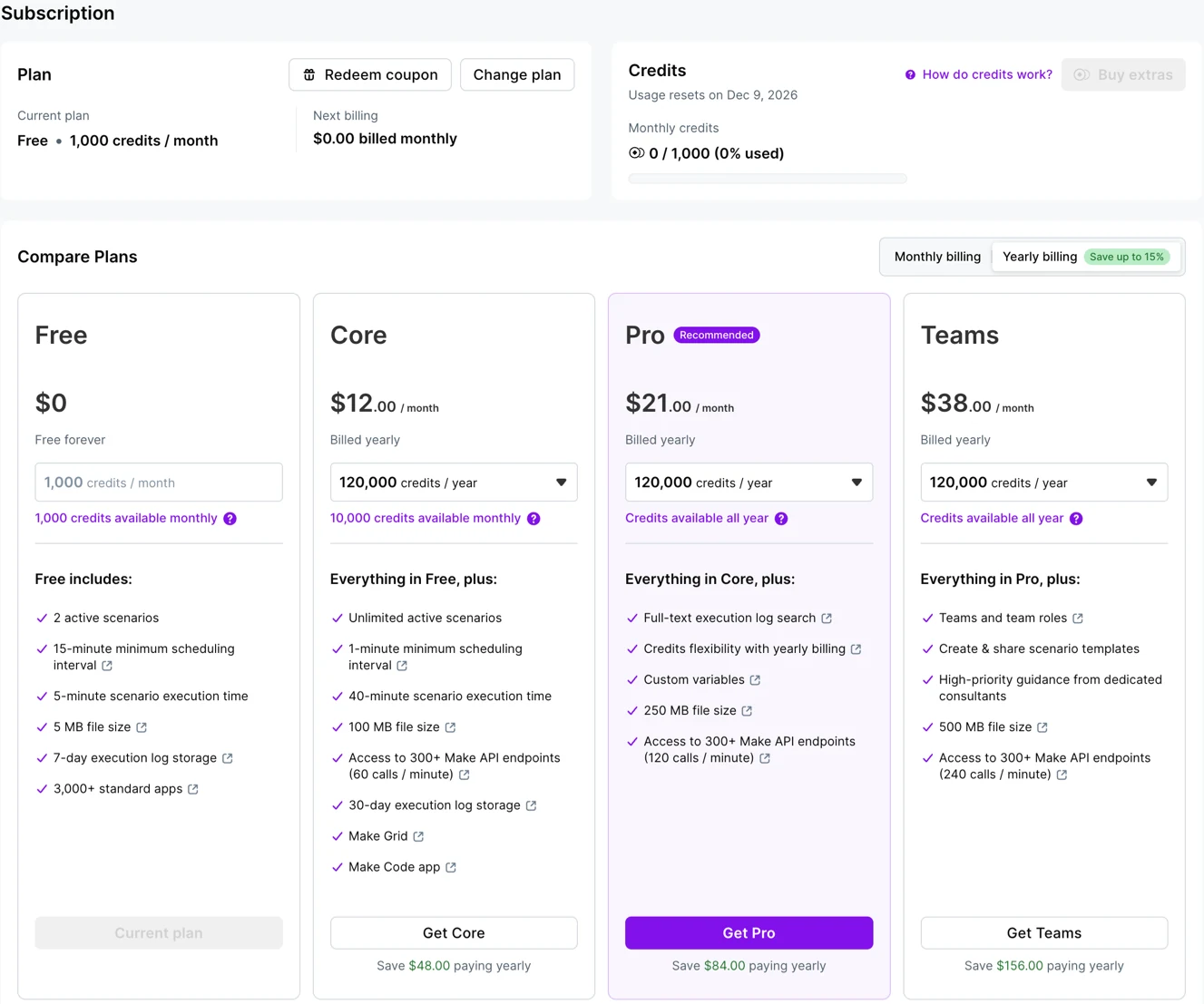
Core, Pro and Teams all get
Active scenariosUnlimited Per Make pricing page, read Nov 9, 2026 (source)
Minutes between scheduled runs1 Per Make pricing page, read Nov 9, 2026 (source)
Max minutes per run40 Per Make pricing page, read Nov 9, 2026 (source)
Execution logs kept30 days Per Make pricing page, read Nov 9, 2026 (source)
How credits behave
What uses a creditMost module actions use one credit, so one scenario run can use from two credits to thousands Per Make pricing page, read Nov 9, 2026 (source)
When credits run outScenarios stop until credits are added; incoming webhooks wait in a queue Per Make pricing page, read Nov 9, 2026 (source)
At the end of the termUnused credits expire at the end of the term Per Make pricing page, read Nov 9, 2026 (source)
Yearly billingOn yearly billing, Pro and Teams credits can be used at any point in the year; Core credits arrive month by month Seen in a Make account opened Nov 9, 2026 (source)

Running client accounts
Make groups scenarios, users and data into organizations. For an agency, that is the unit to plan around.
Choose the region when you create a client's organization: US or EU data center, chosen per organization and fixed once created Per Make Help Center, read Nov 9, 2026 (source)
Opening a Make account
StackSmithy opened a Make account on , billed in the US. Personal details are hidden in the screenshots.
Sign up and pick a region
The form asks for: Work email, full name, hosting region and country; no payment card Seen in a Make account opened Nov 9, 2026 (source)
The region matters for client work: US or EU data center, chosen per organization and fixed once created Per Make Help Center, read Nov 9, 2026 (source)
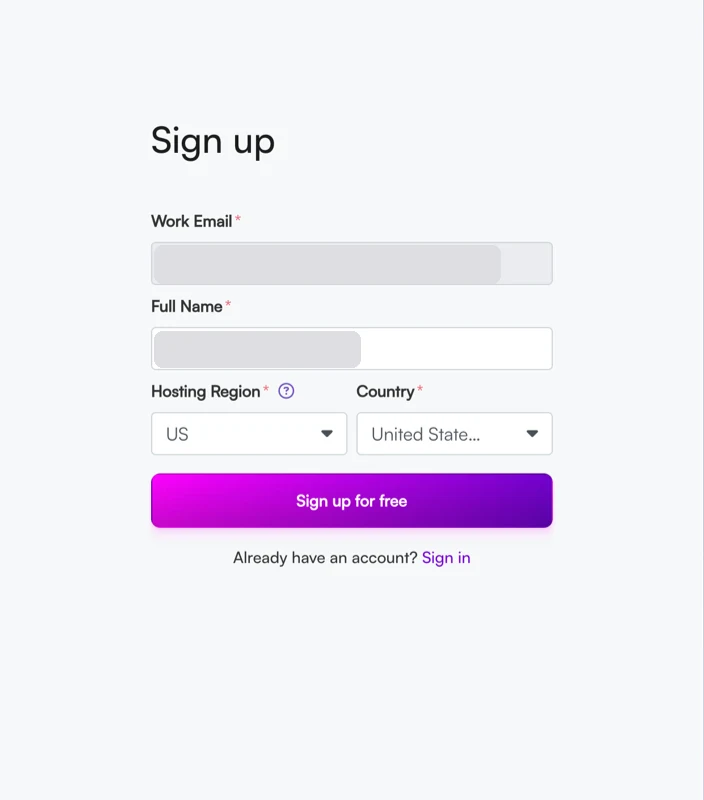
Sign-up form. Email and name hidden by StackSmithy. Answer two short questions
Questions on what you want to automate and which apps you use; the app step can be skipped Seen in a Make account opened Nov 9, 2026 (source)
Land in your first organization
A new account starts on the Free plan, in an organization called My Organization with one team called My Team Seen in a Make account opened Nov 9, 2026 (source)
For an agency, this first organization is your own. Each client gets a separate one, with its own plan.
On the Free plan: 0 / 1,000 monthly credits used, with the reset date shown Seen in a Make account opened Nov 9, 2026 (source)
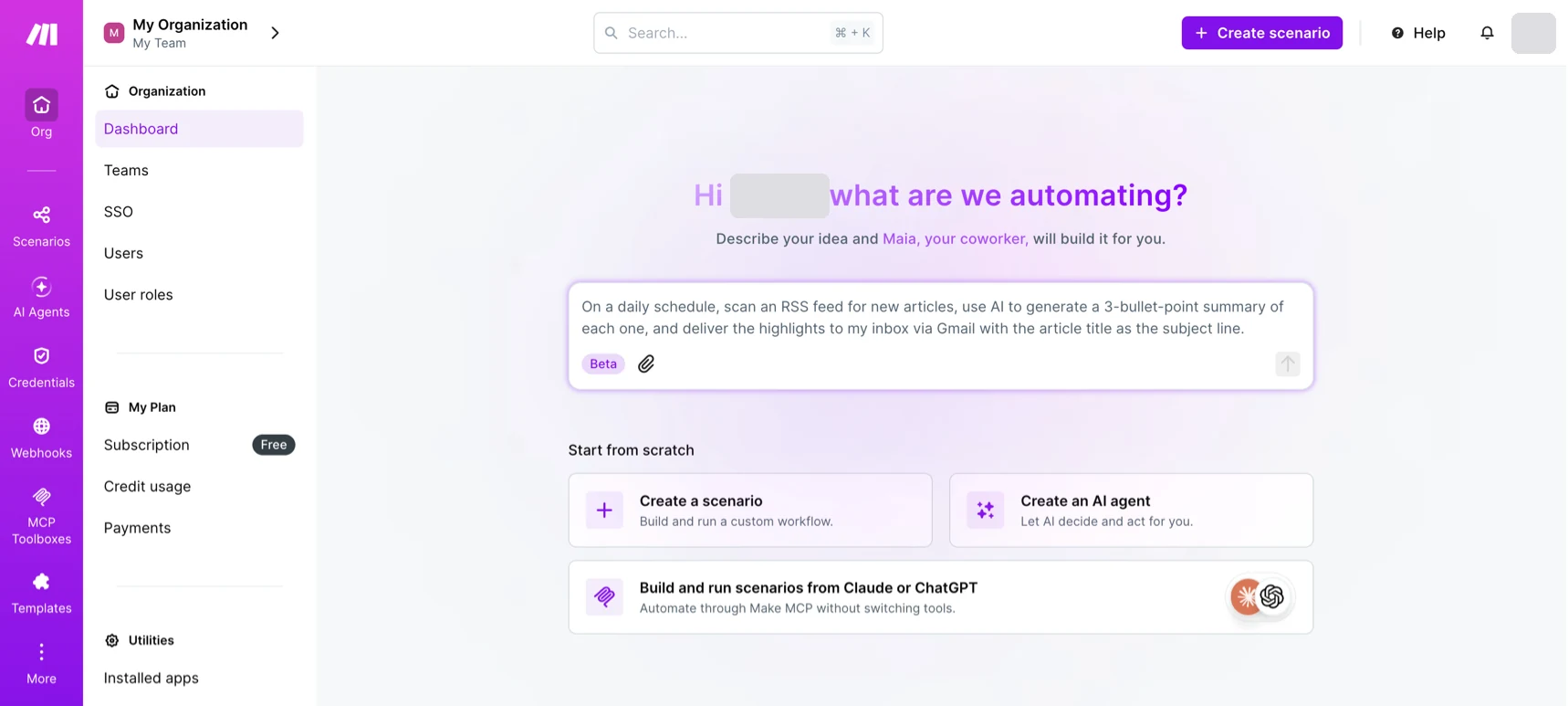
A new account's dashboard, with the organization menu on the left. Name hidden.

In its favor
- Each client can have its own organization and bill: Each organization has its own plan and billing, and its credits are tracked separately Per Make Help Center, read Nov 9, 2026 (source)
- A finished account can be handed to the client: The owner can hand the organization over to another member Per Make Help Center, read Nov 9, 2026 (source)
- Clients can supply their app logins without seeing your work: A Guest role that mainly receives credential requests, without general access to team data Per Make Help Center, read Nov 9, 2026 (source)
Against it
- Costs follow the number of steps, not the number of runs: Most module actions use one credit, so one scenario run can use from two credits to thousands Per Make pricing page, read Nov 9, 2026 (source)
- Running out of credits stops client automations: Scenarios stop until credits are added; incoming webhooks wait in a queue Per Make pricing page, read Nov 9, 2026 (source)
- Credits you do not use are lost: Unused credits expire at the end of the term Per Make pricing page, read Nov 9, 2026 (source)
Which to pick
Pick Make if
You want each client in its own organization, with its own plan and bill, and the option to hand the account over when the project ends.
Look elsewhere if
Your scenarios have many steps and run often, since every module action uses credits, or if you need to host the tool on your own servers.
This verdict follows from Make's pricing page, its Help Center and opening a Free account, not from running client work on Make.